01How a sheet works
Arabic runs from right to left, so every line on a sheet starts at the right-hand edge. The first line is the model, with its vowel marks. The next lines draw the letters as dashed outlines: trace over them slowly, keeping inside the shape. Then come lines in light grey to write over with a firmer hand, and last, empty lines where you write without help.
The solid line is the baseline: most letters sit on it. The tails of ر and و dip below it, as do those of ن and ع when they stand alone or end a word. The dotted line above it helps you keep the letters the same size.
The dashed outlines leave out the reading marks, the short vowels and the shadda among them, so that your hand follows the letters themselves; the model and the grey lines keep them. In each joined group, write the letters without their dots first, then add the dots.
02One letter, up to four shapes
Most Arabic letters change shape with the way they join: alone, joined to the next letter (the start of a joined group), joined on both sides (the middle) and joined to the letter before (the end). On the sheets, the short line ـ, called tatwīl, stands for the stroke that joins a neighbour, so you practise the join as well as the letter.
Dots carry a lot of the work. ج ح خ share one shape, and the two letters of each pair س ش, ص ض, ط ظ and ع غ share one too; in their start and middle shapes, ب ت ث ن ي also share one. Count the dots, and put them above or below where they belong.
Three letters in three places: بـ starts the word, ـيـ sits in the middle and ـت ends it. At the start and in the middle, ب and ي have the same tooth; the dots tell them apart.
03Six letters never join the next one
ا د ذ ر ز و can join the letter before them but never the one after. They have only two shapes, alone and joined to the letter before, and the letter that follows them starts a new joined group, as it would at the start of a word. A word can therefore break into several joined groups, with a gap after each of these six letters.
When lām is followed by alif, the two are written as one shape: لا. A sheet made from your own word draws it that way.
Three pieces: مد, then ر, then سة. The د and the ر stop the join, so the letter after each one starts again.
Three letters that never join the next one, so the word is three separate shapes.
04A sheet from your own word
Type a word, a name or a short phrase in Arabic letters: up to 24 letters, in four words at most, with or without vowel marks. The model line keeps the vowels you typed; the dashed outlines leave them out.
The sheet does not turn Latin letters into Arabic ones: write a name such as Sarah in Arabic first (سارة). Letters from a Persian or Urdu keyboard, such as پ and گ, or the ک and ی those keyboards type, are refused: they are not the Arabic letters, and the sheet would teach the wrong shape. Switch to an Arabic keyboard instead.
The sheet is drawn in your browser: the word you type is not sent anywhere.
05Print it, or keep it as a PDF
Each sheet fits one page of A4 or Letter: choose the paper size in the print window, and choose “Save as PDF” there to keep a file. “Print all 28 letters” gives a 28-page booklet, one letter per page, in alphabetical order.
Print as many as you need, for yourself or for a class. Each page carries this page's address at the bottom, so a copy handed out leads back to the blank sheets.
06The 28 letters and their shapes
The chart gives each letter’s shape at the start, in the middle and at the end of a word, with the word its sheet uses. The six letters that never join the next one start a word in their lone shape and keep their end shape in the middle. In the middle of a word, the letter before also counts: after one of those six, the next letter is written as at the start of a word. In وَرْد, the ر stands alone.
| Alone | Start | Middle | End | Word on its sheet |
|---|---|---|---|---|
| ا alif | ا | ـا | ـا | نَار — fire |
| ب bāʾ | بـ | ـبـ | ـب | بَاب — door |
| ت tāʾ | تـ | ـتـ | ـت | تِين — figs |
| ث thāʾ | ثـ | ـثـ | ـث | ثَوْب — garment |
| ج jīm | جـ | ـجـ | ـج | جَبَل — mountain |
| ح ḥāʾ | حـ | ـحـ | ـح | حَقْل — field |
| خ khāʾ | خـ | ـخـ | ـخ | خُبْز — bread |
| د dāl | د | ـد | ـد | دَار — house |
| ذ dhāl | ذ | ـذ | ـذ | ذَهَب — gold |
| ر rāʾ | ر | ـر | ـر | رَأْس — head |
| ز zāy | ز | ـز | ـز | زَهْرَة — flower |
| س sīn | سـ | ـسـ | ـس | سَمَاء — sky |
| ش shīn | شـ | ـشـ | ـش | شَمْس — sun |
| ص ṣād | صـ | ـصـ | ـص | صَبْر — patience |
| ض ḍād | ضـ | ـضـ | ـض | ضَوْء — light |
| ط ṭāʾ | طـ | ـطـ | ـط | طَرِيق — road |
| ظ ẓāʾ | ظـ | ـظـ | ـظ | ظِلّ — shade |
| ع ʿayn | عـ | ـعـ | ـع | عَيْن — eye, spring |
| غ ghayn | غـ | ـغـ | ـغ | غَابَة — forest |
| ف fāʾ | فـ | ـفـ | ـف | فِيل — elephant |
| ق qāf | قـ | ـقـ | ـق | قَمَر — moon |
| ك kāf | كـ | ـكـ | ـك | كِتَاب — book |
| ل lām | لـ | ـلـ | ـل | لَيْل — night |
| م mīm | مـ | ـمـ | ـم | مَاء — water |
| ن nūn | نـ | ـنـ | ـن | نَهْر — river |
| ه hāʾ | هـ | ـهـ | ـه | هَوَاء — air |
| و wāw | و | ـو | ـو | وَرْد — roses |
| ي yāʾ | يـ | ـيـ | ـي | يَد — hand |
07Then check what you wrote
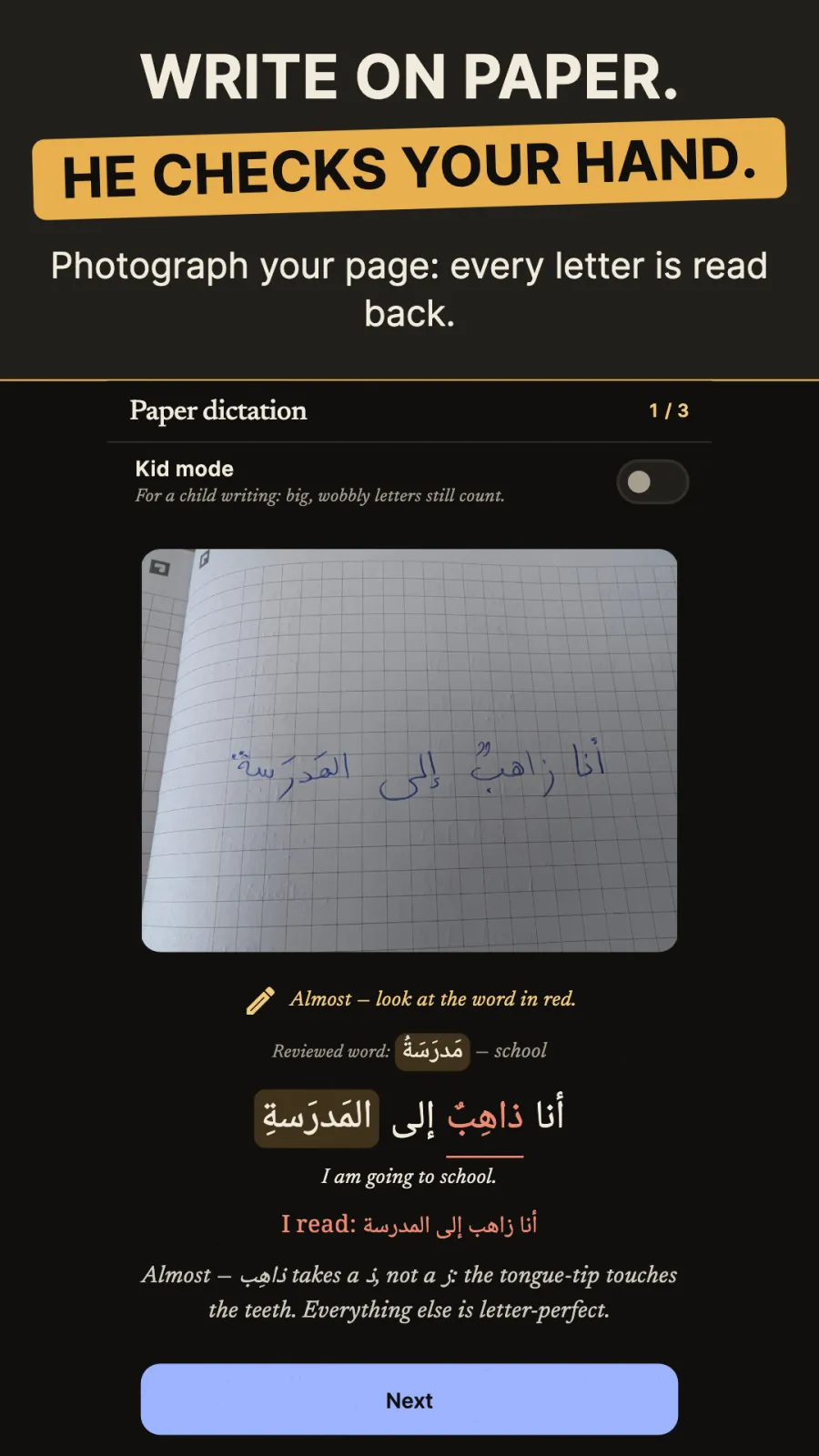
Tracing teaches the shapes; writing them from memory shows whether you know them. That is the step Kalima checks. Handwriting checked from a photo of your paper: letters for beginners, a dictation for readers.